
Gibson's albatross
| Gibson's albatross | |
|---|---|
 |
|
| In flight off south-eastern Tasmania | |
| Scientific classification | |
| Kingdom: | Animalia |
| Phylum: | Chordata |
| Class: | Aves |
| Order: | Procellariiformes |
| Family: | Diomedeidae |
| Genus: | Diomedea |
| Species: | D. antipodensis |
| Subspecies: | D. a. gibsoni |
| Trinomial name | |
|
Diomedea antipodensis gibsoni Robertson & Warham, 1992 |
|
| Synonyms | |
|
|
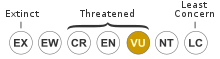
Gibson's albatross (Diomedea antipodensis gibsoni), also known as the Auckland Islands wandering albatross or Gibson's wandering albatross, is a large seabird in the great albatross group of the albatross family. The common name and trinomial commemorate John Douglas Gibson, an Australian amateur ornithologist who studied albatrosses off the coast of New South Wales for thirty years.
To authorities who accept the split of the Antipodean albatross from the wandering albatross, Gibson's is a subspecies of the Antipodean. To authorities not accepting the split, Gibson's is a subspecies of the Wandering. It is also sometimes considered a full species, Diomedea gibonsi, and the term wandering albatross is sometimes considered a species complex which includes the species D. gibonsi.
Similar in appearance to the wandering albatross, adult birds have white on the back, extending along the upper surface of the wings near the body. The white plumage of the head and body has fine grey barring. The upper wing has a black trailing edge, with black flight feathers and with mottled white patches on the black primary coverts. The underwing is white with a dark trailing edge. The tail is white with black edges, except in older males in which it may be completely white. The bill is pale pink. Females are slightly duller and smaller than males. The taxon is generally paler than the nominate subspecies of Antipodean albatross, D. a .antipodensis, which breeds mainly in the Antipodes Islands. Adult males have a mean weight of 6.8 kg and females of 5.8 kg.
Gibson's albatross breeds only in the subantarctic Auckland Islands archipelago of New Zealand. Breeding females feed mainly in the Tasman Sea, while the males forage further south in the sub Australian or mid Pacific sectors of the Southern Ocean between latitudes of 30° and 50° S, especially the Roaring Forties where the weather systems assist their foraging. Though they may sometimes travel as far south as the edge of the Antarctic pack-ice in late summer, they are rarely seen south of the Antarctic Convergence in winter.
...
Wikipedia