
Hispaniolan trogon
| Hispaniolan trogon | |
|---|---|
 |
|
| Scientific classification | |
| Kingdom: | Animalia |
| Phylum: | Chordata |
| Class: | Aves |
| Order: | Trogoniformes |
| Family: | Trogonidae |
| Genus: | Priotelus |
| Species: | P. roseigaster |
| Binomial name | |
|
Priotelus roseigaster (Vieillot, 1817) |
|
| Synonyms | |
|
Temnotrogon roseigaster |
|
Temnotrogon roseigaster
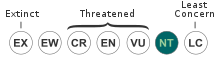
The Hispaniolan trogon, Priotelus roseigaster, (now mostly accepted as Temnotrogon roseigaster) is a species of bird in the family Trogonidae. It is the national bird of Haiti. It is endemic to Hispaniola Island in the Caribbean, an island shared by Haiti and the neighbouring Dominican Republic. It is one of the only two trogon species found only on the Caribbean islands. Its natural habitats are subtropical or tropical moist montane forests and what is now heavily degraded forest. It is threatened by habitat loss. It is mostly confined to a few remaining protected areas.
Trogons are brightly coloured birds with long, strongly graduated tails, small feet, and short, thick bills. The Hispaniolan Trogon has metallic green upperparts, a gray throat and breast, and a red belly and is separated from the closely related Cuban trogon by the more typical tail of this species. The underside of the tail is dark, but each rectrix is broadly tipped with white. Males and females look similar but the females' wing coverts and secondaries lack the narrow white bars. The male average measurements for wing, tail, culem from base and tarsus are 135.2, 154, 17.3, 16.8 mm respectively. The female averages are 136.6, 154, 16.5, 16.4 mm
The song is rather slow and can be heard from quite a distance. It has a low rattle.
It inhabits rain, dry, pine and broadleaved deciduous forests. Several early records included mangrove swamps west of Miragoane but whether these were visitors or a resident population is unknown. It requires large, old decayed trees with holes for nesting. It primarily occurs at 500-3,000 m, but there appears to be some altitudinal migration with birds observed at lower elevations in winter. It is now restricted to the Massifs de la Hotte and de la Selle due to extensive habitat loss in Haiti. It is still quite common in the Dominican Republic, especially in the relatively undisturbed Sierra de Baoruco, although there has been a moderately rapid population reduction, owing to deforestation.
...
Wikipedia